For most of the last twenty years, the received wisdom in Western steel markets has been that Chinese steel is cheap and Western steel is better. That statement was directionally true through the 2000s and much of the 2010s. It is no longer accurate as a blanket generalisation, and pretending otherwise is doing a disservice to buyers, competitors and policymakers alike.
I have spent significant portions of my career operating in and around Chinese steel. I ran BlueScope Butler’s China business for a period, directing a US$300 million operation with 1,250 employees across engineering, manufacturing and construction. I have watched the trajectory of Chinese mill capability from the inside. The quality story is not the same story it was a decade ago, and refusing to update the mental model is a mistake.
THE OLD STORY
The old story went something like this. Chinese mills were cost-competitive because of scale, cheaper labour, cheaper energy and lower regulatory overhead. But quality was variable. Metallurgical consistency was uneven. Coating-line discipline was not what it was in Japan or Korea or the legacy Western producers. Trace-element control was inconsistent. Certification and traceability were sometimes creative in their interpretation. All of that was, on balance, true through the early 2010s.
The premise most Western buyers built their supply strategy on was that the cost advantage was real, but that for anything genuinely quality-critical you needed to buy from a Japanese, Korean, European or North American mill. Chinese steel was for commodity applications. Anything with tight specifications went elsewhere.
WHAT HAS ACTUALLY CHANGED
The Chinese steel industry has spent the last fifteen years doing what industries do when they have both scale and capital: investing in equipment, process control, quality-management systems and the industrial engineering that underpins consistency. The result is a top tier of Chinese mills that operate to specifications and consistency levels that are competitive with the best producers anywhere in the world.
That is not every Chinese mill. It is not even most Chinese mills. The Chinese industry is huge and heterogeneous, and there is still a long tail of variable-quality producers.
The top tier is genuinely a top tier now.
Certain Chinese producers of automotive-grade cold-rolled and coated steel, of construction-grade structural sections, of high-tensile plate, produce product that is metallurgically indistinguishable from what a legacy Western or Japanese producer would supply for the same application.
Key Chinese producers of coated and painted material for the building and construction sector when using the same raw material inputs (paints, coating metals, pre-treatments) as those 1st tier producers such as BlueScope on equipment that is newer, faster and with better process control can, in my view, produce a consistently better product.
The buyers who continue to pay a premium for non-Chinese product on the assumption that Chinese quality is not there are paying for a distinction that in many product categories no longer exists. The buyers who insist on Chinese product because it is cheaper without doing the diligence on which mill are exposing themselves to the tail of the distribution, where quality can still be genuinely inconsistent. The right answer is more nuanced than either.
WHY THIS IS UNCOMFORTABLE FOR THE INDUSTRY
The old story was comfortable for everyone. Western producers could compete on quality without needing to compete on cost, because the quality gap justified the price premium. Buyers could feel virtuous about paying more, because they were buying better product. Trade policy could be framed straightforwardly as protecting quality-focused domestic producers against cheap imports of a lesser product.
The new story is more difficult. If the quality gap has closed in many product categories, the competitive argument shifts. Cost advantage that used to be offset by quality risk is now cost advantage that stands on its own. Trade-remedy measures against the same product become harder to justify on quality grounds and have to be justified on trade-fairness grounds, which is a different argument. And Western producers who have relied on the quality-premium narrative have to reassess where their durable competitive advantages actually sit.
None of this is a comfortable conversation, which is why the industry has been slow to have it publicly. But it is happening quietly at every serious buyer’s procurement table, and it should be happening publicly too.
WHERE THE GAP DOES STILL EXIST
To be fair, the quality story is not uniform across all products. There are still categories where the top-end Japanese, Korean and European producers hold a meaningful edge, generally in the highest-specification applications or in categories where multi-decade metallurgical R&D is genuinely differentiating. Ultra-high-strength automotive steels for certain OEM programmes are an example. Highly specialised electrical steels are another. Some grades of pipe-line steel with the tightest sour-service requirements are another.
These are the categories where the premium is still defensible on quality grounds. But they are a subset of the market, not the whole market. For general structural, general coated, general cold-rolled and general hot-rolled at commodity specifications, the story has changed.
WHAT IT MEANS FOR BUYERS AND OPERATORS
For buyers, the implication is that supplier evaluation needs to be more sophisticated than it used to be. Blanket assumptions about country-of-origin quality are unreliable. Individual mill-level evaluation, technical audits of specific production lines and traceable QA data are what separate good sourcing decisions from lucky ones.
For domestic producers competing against imported product, the implication is that the competitive positioning has to be based on real differentiators. Delivery predictability. Technical support depth. Standards alignment for local jurisdictions. Local warranty and remedy exposure. Supply-chain resilience. These are areas where a well-run domestic producer can build genuine sustained advantage. They are not areas where a general assertion of quality superiority does the work anymore.
For anyone building trading infrastructure in this market, the implication is that quality provenance is now a first-class piece of the transaction. Mill test certificates, standards-compliance data, coating and metallurgical records tied to the specific shipment are not a nice-to-have. They are how a buyer distinguishes the top tier of Chinese supply from the long tail, and they are how a serious platform builds the trust that lets a market function.
CLOSING
The Chinese steel industry has changed. The cost-competitive story is decades old and well understood. The quality-competitive story is more recent, less discussed and, in many product categories, equally real. Anyone in the industry still operating on the old mental model – buyer, seller, competitor or policymaker – is working from an outdated map.
None of that is a value judgment. It is an observation about where the industry has gone, from someone who has spent enough time inside it to have watched the change happen. The businesses that update the map earliest will make better decisions than the ones that hold on to the old one.
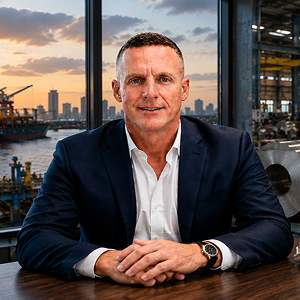
Jason Thomas Ellis
Jason Thomas Ellis is Executive Chairman of iTrade Steel Pty Ltd and Chairman of Empower Steel Australia Pty Ltd. He has held senior leadership roles across BlueScope Steel, Tata BlueScope Steel, Commercial Metals Company, Butler and BHP Lysaght, operating businesses across Australia, India, China, Thailand, Cambodia, Laos, Myanmar and Sri Lanka. He holds a BA (Political Science) from the University of Sydney and an MCom (Finance) from the University of Wollongong, and is a Fellow of the Australian Institute of Company Directors.