
Steel is the most globalised industrial commodity on the planet. It crosses borders, changes currencies, moves through half a dozen intermediaries, and settles against contracts written in dialects of English that would not look out of place in a 1970s trading room. The physical product has kept pace with the modern economy – grades, coatings, tolerances and supply-chain footprints are all more sophisticated than they were a decade ago. The trading layer that moves steel from mill to end user has not. And that gap is what iTrade Steel exists to close.
I have spent thirty years inside global steel – at BHP, twenty-five of them with BlueScope, and in senior executive roles across Australia, Southeast Asia, India and China. Across all of it, one observation kept surfacing in different forms: the trading and distribution layer is where the industry loses the most value, not to any single actor, but to a series of small frictions repeated a thousand times over. Multiple intermediaries. Opaque pricing. Slow paper trails. Fragmented logistics. Manual reconciliation between mills, buyers, financiers and freight. None of it dramatic on its own. Cumulatively, an enormous drag on how the market actually functions.
WHY THE STEEL TRADING LAYER LOOKS THE WAY IT DOES
Steel trading did not become fragmented by accident. Historically, mills were regional, buyers were dispersed, and the intermediation layer developed to solve real problems – price discovery, credit intermediation, quality reassurance, and logistics coordination across markets that did not speak to each other in real time. The traders, brokers, agents and distributors who occupy that layer are, in most cases, doing genuine work that the market needed done.
What has changed is that most of that work is now easier to do digitally than it is to do manually. Real-time pricing, transparent order matching, integrated logistics, escrow-style financial settlement and end-to-end shipment visibility are all standard features of modern digital marketplaces in adjacent categories. Steel has been slower to adopt them because the physical logistics are heavy, the counterparty risk is high, and the industry’s incumbents are, understandably, reluctant to disintermediate revenue streams that have compounded for decades.
The result is a trading layer where the buyer often does not see the mill price, the mill often does not see the end user, and both sides pay for that opacity in different currencies – the buyer in landed cost, the mill in margin compression and demand-signal noise. When markets move, the friction shows up as delayed decisions, mispriced inventory and orders that get cancelled or renegotiated well downstream of where the signal originated.

WHAT A MODERN STEEL MARKETPLACE ACTUALLY DOES
The proposition of a digital steel marketplace is not to eliminate the intermediation layer wholesale. It is to consolidate the useful functions of that layer into a single infrastructure stack that participants can trust, and to strip out the parts of it that exist only because there was no better way.
In practice, that means four things running in parallel.
First, direct price and product visibility. End-use buyers see mill and origin-level pricing on the products they specify. Mills see aggregated, real-time demand signal from the buyer base. Neither has to guess what the other will accept, and neither has to work through three layers of interpretation to find out. Price discovery becomes a function of the platform rather than of relationships alone.
Second, integrated financial settlement. Steel trading has always been credit-heavy. A modern platform absorbs that credit intermediation into standardised, escrow-style settlement, with recognised financial counterparts on the other side. The buyer’s payment terms are clear. The mill’s collection risk is bounded. The financial counterpart’s exposure is transparent. The old game of who is willing to extend credit to whom, at what implied cost, gets replaced by a defined settlement protocol.
Third, logistics and documentation integration. Freight booking, customs documentation, insurance and shipment tracking are treated as first-class citizens on the platform rather than as afterthoughts handled off-system. This is where most of the small daily frictions in physical steel trading actually live. Bringing them onto the platform is what turns a marketplace from a pricing tool into an operating system for the trade.
Fourth, quality and compliance provenance. Mill test certificates, standards compliance, origin data and inspection records are digitised, verifiable and attached to the shipment. In a market where quality disputes have historically been resolved through relationships and paperwork, moving that layer onto a verifiable digital record is a category shift.
WHY NOW
Three conditions have converged over the last five years that make the digital marketplace approach viable for steel in a way that was not true earlier. Digital infrastructure has matured to the point where high-value physical transactions can be settled on-platform with acceptable risk. End-use buyers – construction, manufacturing, engineering – have moved almost entirely to digital procurement systems for other categories, and expect the same interface for steel. And the sheer volume of small daily frictions in traditional trading has become expensive enough, in a market with tightening margins, to justify the operational shift.
The mills that engage with digital marketplaces early gain a direct read on end-use demand that they cannot get through their traditional channels. The buyers gain price transparency and delivery predictability that their existing procurement processes cannot match. The financial and logistics counterparts gain access to a transaction pipeline that is easier to underwrite than the historical alternative. None of this happens overnight, and none of it displaces the existing distribution channels wholesale. But the direction of travel is clear.
WHAT iTRADE STEEL IS BUILDING
iTrade Steel is being built as that infrastructure layer for global steel trading – a platform where end-use customers, mills, logistics providers and financial counterparts transact on a shared, standardised, transparent interface. The ambition is not incremental improvement on the traditional trading model. It is to compress the intermediation stack, expose the underlying pricing, and give participants on both sides of the trade the operating clarity they need to move faster and with less risk.
The industrial demand for that infrastructure is real, and the technical capability to deliver it is now within reach. Steel is one of the last major global commodities where the trading layer has not been rebuilt around modern digital infrastructure. It will not stay that way indefinitely.
The next phase of the industry will belong to the platforms that get the trading layer right – and to the mills, buyers and counterparts who engage with those platforms early enough to shape how they develop.
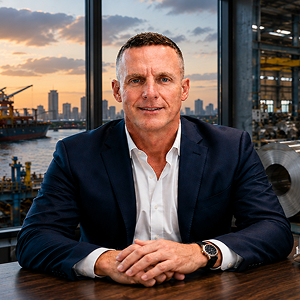
Jason Thomas Ellis
Jason Thomas Ellis is Chairman of Empower Steel Australia Pty Ltd and Executive Chairman of iTrade Steel Pty Ltd. He has held senior leadership roles across BlueScope Steel, Tata BlueScope Steel, Commercial Metals Company, Butler and BHP Lysaght. He holds a BA (Political Science) from the University of Sydney and an MCom (Finance) from the University of Wollongong, and is a Fellow of the Australian Institute of Company Directors.