
Painted and coated steel sits in an unusual position in the Australian construction market. It is one of the most quietly consequential materials in modern building — roofing, walling, structural cladding, manufactured products — and it is also one of the most under-discussed. Specifiers tick a box, builders order a coil, the product arrives, and the assumption is that what is inside that coil is the same as what was inside the last one. Most of the time it is. Sometimes it is not. And the difference, over twenty or thirty years of building life, is not academic.
I spent twenty-five years inside BlueScope Steel, in operational and senior executive roles across Australia and Southeast Asia. The work taught me, among many other things, that the gap between an excellent coated-steel coil and a marginal one is built up from dozens of small decisions long before anything reaches a customer. Substrate metallurgy. Coating-line discipline. Curing conditions. Quality-control rigour. Standards alignment. Logistics handling. Each one is a place where corners can be cut. The cumulative cost of cutting them does not always show up immediately — but it always shows up.
That perspective is part of why I serve today as Chairman of Empower Steel Australia, and why I write about this product category at all.
WHAT “QUALITY” ACTUALLY MEANS IN COATED STEEL
When a builder, fabricator or specifier asks for “high-quality painted and coated steel,” they are usually asking — sometimes without articulating it — for four things at once.
First, substrate integrity. The underlying steel coil has to be metallurgically consistent across the run. Tensile properties, surface preparation and dimensional tolerances all need to sit within tight bands. A variable substrate produces variable end-product performance, no matter how good the coating is.
Second, coating system performance. The metallic coat (zinc, aluminium-zinc, magnesium-aluminium-zinc alloys depending on the application) and the organic paint system above it are engineered together. The thickness, uniformity and adhesion of each layer are what determine whether the product still looks and performs as specified in twenty years’ time. Coating-line speed, oven temperature curves and applicator condition all sit upstream of the result. They are not negotiable variables in a serious operation.
Third, standards alignment. Australian, New Zealand and Thai industrial standards are not interchangeable, and a product engineered with attention to all three is materially different from one produced to a single national specification. The trans-Tasman construction market, in particular, has long demanded products that perform identically against AS/NZS specifications, and the discipline required to meet that bar consistently is greater than it is sometimes given credit for.
Fourth, batch-to-batch consistency. The single most underrated quality attribute is reproducibility. A product that is excellent some of the time and average the rest of the time is not a high-quality product — it is a product the market will eventually price down accordingly. Consistency is built through QA discipline, not through specification documents.
WHY EMPOWER STEEL EXISTS
Empower Steel Australia produces high-performance painted and coated steel from a Thailand manufacturing base, designed and engineered specifically for the Australian and New Zealand markets, and aligned across all three jurisdictions’ industrial standards. The proposition is straightforward in its ambition: a more refined, more consistent alternative in a category that has historically been dominated by a small number of established players.
That ambition does not amount to much without execution discipline behind it. The work that makes Empower Steel a credible market entrant — the work I spend my time on in a governance and long-term-strategy capacity — is the slow, unglamorous work of cross-border standards alignment, supply-chain integrity, manufacturing quality control, and customer technical support. Each of those areas takes years of investment to compound, and none of them can be substituted by marketing.
The market does not need more painted steel. It needs more reliably excellent painted steel, delivered consistently, at prices that reflect the real cost of producing it well. That gap is the gap Empower Steel is built to close.
WHAT’S CHANGING IN THE AUSTRALIAN COATED STEEL MARKET
Three structural shifts are reshaping the market for painted and coated steel in the Asia-Pacific over the next decade, and any operator who wants to remain relevant has to be thinking about all three.
The first is the rebalancing of regional manufacturing capacity. Local industrial bases across the Asia-Pacific are being rebuilt for reasons that combine economics, resilience and geopolitics. Coated-steel supply chains that depended on stable cross-border arrangements established in the 1990s and 2000s are being reorganised. The operators who win the next cycle will be the ones with genuine multi-jurisdiction footprints and the discipline to operate them as one integrated system rather than as a collection of national businesses.
The second is the increasing expectation, particularly from architects and specifiers, that coated steel products carry transparent, verifiable provenance — not just performance certification, but visibility into substrate origin, coating system, manufacturing date and quality testing. This is a level of supply-chain visibility the sector has historically been comfortable not providing. That comfort will not last.
The third is the steady tightening of building-performance standards across both Australia and New Zealand. The trans-Tasman construction market is moving — slowly, but in one direction — toward higher-performance envelopes, longer expected service lives, and more rigorous warranty regimes. Coated-steel products that struggle to meet today’s middle-of-the-pack expectations will struggle even more to meet tomorrow’s.
None of these shifts is hostile to good operators. All three reward investment in product engineering, supply-chain integrity and quality-control discipline. They penalise short-termism. That, more than any specific market trend, is what I find most worth saying about this sector at this moment.
CLOSING
Painted and coated steel is not a glamorous product category. The decisions that determine whether a coil is excellent or marginal are made on factory floors and in QA labs, not in boardrooms or marketing copy. But the products that come off those lines are clad onto millions of buildings and manufactured products across Australia and New Zealand every year, and the difference between good steel and indifferent steel is the difference between a building that does its job for forty years and one that does not.
I work in this sector because the work matters and because the standard is real. The companies that hold that standard, and the operators who insist on it day after day, are doing work the wider economy depends on whether or not it notices. That work is worth doing well.
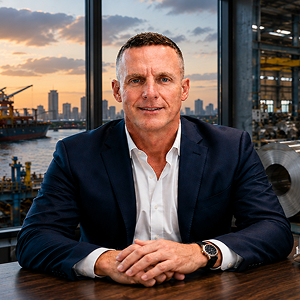
Jason Thomas Ellis
Jason Thomas Ellis is Chairman of Empower Steel Australia Pty Ltd and Executive Chairman of iTrade Steel Pty Ltd. He has held senior leadership roles across BlueScope Steel, Tata BlueScope Steel, Commercial Metals Company, Butler and BHP Lysaght. He holds a BA (Political Science) from the University of Sydney and an MCom (Finance) from the University of Wollongong, and is a Fellow of the Australian Institute of Company Directors.